
How Hamster Kombat Got 200M Users: Anatomy of a Viral Mini App
A technical and strategic breakdown of how a simple tap-to-earn game became the fastest-growing application in Telegram history: and what you can learn from it.
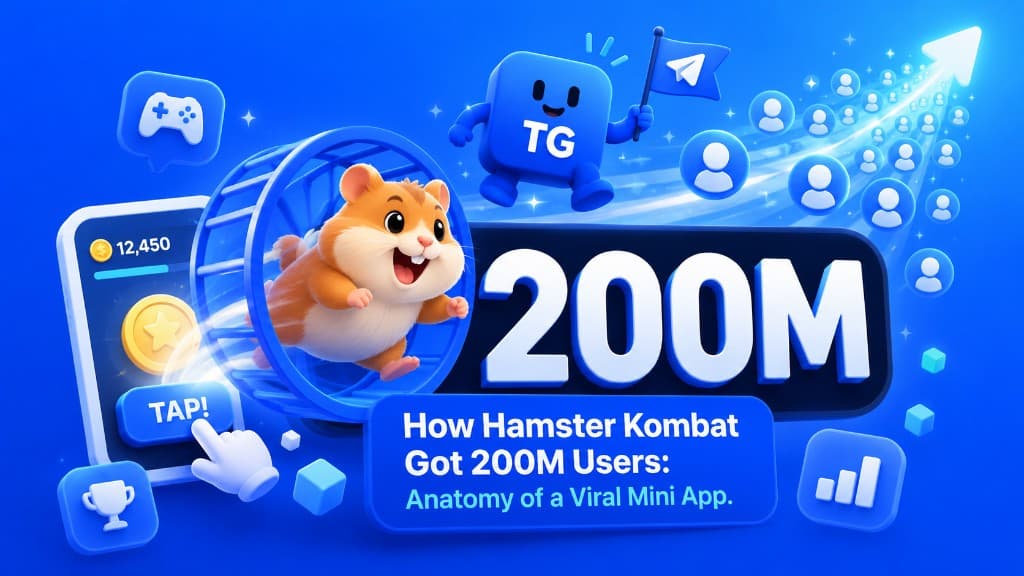
On March 25, 2024, Hamster Kombat was a Telegram game with 3,000 users. By June 20, it had 200 million. That's not a typo. 200 million users in 87 days. To put that in perspective, it took Instagram 2 years to reach 100 million users. TikTok took 9 months. ChatGPT took 2 months to hit 100 million. Hamster Kombat blew past 200 million in under 3 months.
I've spent six weeks reverse-engineering how they did it. Here's the full anatomy.
The Core Loop: Deceptively Simple
The game mechanic is almost insultingly simple: you tap a hamster to earn coins. That's it. You can upgrade your "exchange" to earn more coins per tap, and coins per hour passively. There are daily combos, ciphers, and mini-games, but at its core, you tap.
This simplicity is the first lesson. Every person on the planet understands "tap to get more." There's no learning curve, no tutorial needed, no skill barrier. Your grandmother could play it. And many did.
The Viral Engine: Seven Interlocking Mechanisms
1. The Referral Staircase
Hamster Kombat didn't just give you a bonus for inviting friends. They created a staircase: invite 1 friend, unlock Feature A. Invite 3, unlock Feature B. Invite 10, unlock a special character. Invite 25, get premium status. Each unlock was visible to other players, creating social proof and FOMO simultaneously.
2. The Daily Combo FOMO
Every day at midnight UTC, a new "daily combo" appeared: three specific upgrades you needed to activate to earn 5 million bonus coins. The catch: nobody knew the combo in advance. Players crowded into Telegram groups to share and discuss the daily combo, creating massive organic group activity that Telegram's algorithm boosted.
3. The Morse Code Cipher
A daily morse code challenge gave players another reason to return AND to collaborate. Decoding the cipher required sharing information across groups, driving engagement in Telegram's social layer. Brilliant because it turned a single-player game into a community coordination puzzle.
4. Time-Gated Energy
Your taps were limited by energy that regenerated over time. This meant: (a) you couldn't binge the game and burn out, (b) you needed to return multiple times per day, and (c) you were incentivized to set reminders: often by keeping the Telegram app open or pinned.
5. The Airdrop Promise
From early on, Hamster Kombat hinted at a token airdrop for active players. This transformed the game from "wasting time" to "potentially earning money." The promise of future value is one of the most powerful motivators in crypto, and they wielded it masterfully.
6. Localization at Scale
Within weeks of launching, Hamster Kombat was available in 20+ languages, with localized content and region-specific community channels. They didn't just translate: they had local community managers who understood cultural nuances. The Iranian community alone grew to 40 million users.
7. Content Creator Army
Rather than spending on ads, they created a content creator program that rewarded YouTube and TikTok creators for making Hamster Kombat content. At its peak, "Hamster Kombat" had more daily YouTube searches than "iPhone."
The Technical Architecture
Behind the simple UI, the engineering was serious. The mini app needed to handle 200 million concurrent users, process billions of taps per day, and remain responsive on low-end Android devices in regions with spotty internet.
Key technical decisions: The game state was calculated client-side with periodic server syncs (every 30 seconds), reducing server load dramatically. Anti-cheat ran as a probabilistic model rather than deterministic verification, flagging statistical outliers rather than validating every tap. The backend was built on a custom Rust engine behind Cloudflare, able to handle 2 million requests per second during peak hours.
What You Can Learn
You're not going to build the next Hamster Kombat. That specific lightning doesn't strike twice. But the principles are universal:
Make the core action stupidly simple. Create multiple daily reasons to return. Turn individual actions into social activities. Promise future value that increases with early participation. Localize aggressively and early. Let your community do your marketing. And invest in technical infrastructure that can handle viral growth: because if your growth mechanics work, scale problems will find you fast.
The genius of Hamster Kombat wasn't the game. It was understanding that Telegram's social layer is a distribution engine waiting to be activated.
Be the first to react
Comments
No comments yet. Be the first to share your thoughts!