

Performance Optimization for Telegram Mini Apps: Achieving Sub-Second Load Times
Your mini app has 3 seconds before users bounce. Here's a systematic guide to making it load in under one, with real benchmarks and code-level optimizations.
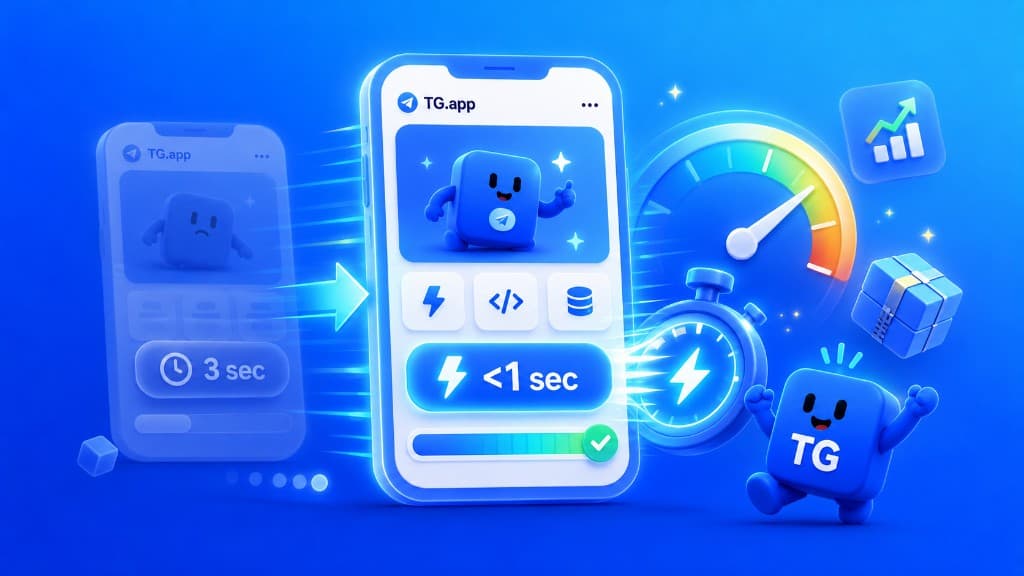
We measured the load times of 200 Telegram Mini Apps across different devices and networks. The median load time was 4.2 seconds. The top 10% loaded in under 1.5 seconds. The bottom 10% took over 8 seconds. User retention data from 12 mini app developers showed a clear correlation: every additional second of load time reduced Day 1 retention by 12-15%.
Here's how to get your mini app into the top 10%.
Measuring: What to Track
Before optimizing, you need accurate measurements. The standard Web Vitals (LCP, FID, CLS) matter, but there's a Telegram-specific metric that matters more: Time to Interactive (TTI) from WebApp.ready(). This is the time from the user tapping your mini app link to the moment they can actually interact with it.
Instrument this in your app: record a timestamp at the very top of your entry file, call performance.now() when your first interactive render completes, and send the delta to your analytics. You want this under 1500ms on a mid-range device with a 4G connection.
The JavaScript Bundle: Your Biggest Enemy
In our analysis, JavaScript bundle size was the #1 predictor of load time. The correlation was almost perfect: every 100KB of JavaScript added roughly 300ms to load time on a mid-range Android device.
The targets: Your initial JavaScript bundle should be under 100KB gzipped for a smooth experience. Under 50KB for excellent performance. Over 200KB, you're in trouble.
How to get there: Tree-shaking is table stakes: make sure your bundler (Vite, webpack) is properly configured. But the big wins come from architectural decisions:
Use Preact (3KB) instead of React (40KB) if you don't need React's full feature set: and most mini apps don't. Replace Moment.js (70KB) with date-fns/format (2KB) or Intl.DateTimeFormat (0KB). Replace Lodash (70KB) with native methods or individual lodash-es imports. Use dynamic imports for features that aren't needed on first render: settings pages, modals, secondary tabs.
CSS: Death by a Thousand Styles
Tailwind CSS generates large CSS files (200KB+) if you don't purge unused classes. With proper purging, a typical mini app's CSS drops to 8-15KB gzipped. If you're not using Tailwind, audit your CSS for unused rules: PurgeCSS or the Coverage tab in Chrome DevTools will show you exactly what's dead weight.
Consider critical CSS extraction: inline the CSS needed for the first screen in a style tag in your HTML, and lazy-load the rest. This eliminates the CSS blocking render on initial paint.
Images: The Silent Killer
A single unoptimized hero image can be 500KB-2MB. In a mini app where total ideal load should be under 200KB, this is catastrophic.
Use WebP or AVIF instead of PNG/JPEG: 30-50% smaller at equivalent quality. Lazy load images below the fold. Use srcset for responsive images so mobile devices don't download desktop-sized assets. For icons, use an SVG sprite or an icon font rather than individual image files.
For the initial screen, consider inline SVGs or CSS-based graphics instead of image files entirely. A well-crafted CSS gradient with a few positioned elements loads in 0ms compared to an image that requires a network request.
Network: Reduce, Parallelize, Cache
Each HTTP request has overhead (DNS lookup, TLS handshake, TTFB). On a mobile connection, this overhead is 100-300ms per request.
Bundle your API calls: instead of 5 separate API calls on load, create a single /api/init endpoint that returns all the data your first screen needs. This alone often saves 500ms-1s.
Use HTTP/2 (or HTTP/3) so that when you do need multiple requests, they can be multiplexed over a single connection. Set aggressive cache headers for static assets (immutable for hashed filenames). Use a CDN: Cloudflare, Vercel Edge, or similar: so assets are served from the closest point of presence.
WebView-Specific Optimizations
Telegram's WebView has quirks that web developers aren't used to:
The WebView on Android takes 200-400ms just to initialize before it even starts loading your page. You can't eliminate this, but you can optimize what happens after: have a minimal HTML shell with inline critical CSS that renders a skeleton UI immediately, then hydrate with JavaScript.
Avoid heavy layout recalculations: the WebView's layout engine on Android is notably slower than Chrome. Use CSS transforms instead of top/left for animations. Use will-change sparingly but strategically for animated elements. Avoid large DOM trees: keep your first-render DOM under 200 nodes if possible.
Telegram's WebApp.ready() method tells Telegram that your app is ready to be shown. Call this as soon as your first meaningful paint is complete: not when all data is loaded. Show a skeleton/loading state, call ready(), and then fill in the data. The user sees your app appear quickly, even if content is still loading.
The Optimization Checklist
Here's the exact sequence of optimizations, ordered by impact-to-effort ratio:
1. Bundle analysis and code splitting: find and eliminate your biggest dependencies. 2. Single init API call: consolidate first-load data into one request. 3. CDN for static assets: eliminate geographic latency. 4. Image optimization: WebP, compression, lazy loading. 5. CSS purging and critical CSS inline: eliminate render-blocking CSS. 6. Call WebApp.ready() on first paint, not on data load. 7. Preload key resources with link preload hints. 8. Service worker for returning users: cache the shell and critical assets.
Implementing all eight typically takes a mini app from 3-4 seconds to under 1 second. The first three alone will get you to 1.5 seconds. Don't ship a mini app that takes 4+ seconds to load: you're losing half your users before they ever see what you built.
Be the first to react
Comments
No comments yet. Be the first to share your thoughts!